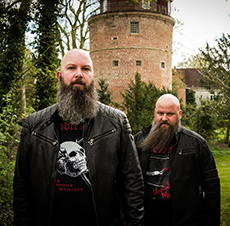
SLAUGHTERDAY deliver a double roundhouse kick and knock everything out of the ring, that isn’t up a tree by the count of three. There’s no other way to describe what’s happening here. “Dread Emperor”, is the band’s sixth album and will be out in February. First singles are already making the rounds as you read these lines. Even more iconic and with a nerd factor of hundred is the 7″ single that was released in the run-up to the album release. We will start our talk with guitarist Jens Finger with this four-track piece of pure noise, titled “Terrified” and then jump into the fire of “Dread Emperor”.
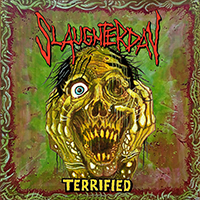
Great, a new SLAUGHTERDAY single, you think to yourself. But wait a minute, the first impulse is: You know that cover artwork…
“That was the plan!“
 How did you come up with the idea of paying tribute to the legendary REPULSION album… Well, to pay tribute to it, only partly – because the songs also contain quite a bit of SLAUGHTERDAY’s own style?
“REPULSION’s “Horrified“ is certainly one of the most influential moments in extreme Metal for us. That raw energy, that uncompromising spirit. It has always been with us. So we wanted to create a tongue in cheek, respectful: “Thank you, you have influenced us!“ The artwork intentionally references the aesthetics of “Horrified“. The four songs naturally carry the strong REPULSION vibe – fast, dirty, direct passages that immediately remind you of the early days of Deathgrind. But as soon as you listen more closely, you realize: this is still clearly SLAUGHTERDAY. The vocals alone, and perhaps also to some extent my riffing or the polyphony, as in the title track, leave no room for doubt.”
How important were REPULSION, who only made this one record, to your personal musical development, and what impact do they have or did they have on SLAUGHTERDAY?
“For us, REPULSION are at a very special point, precisely because they only made this one album. “Horrified“ is a case of: one hit, but one that changed everything. This mixture of Punk attitude, proto Death Metal and completely insane tempo – it was like a big bang back then, and somehow you can still hear it echoing today. In fact, we talked about it in detail in one of our P.A.G.A.N. podcast episodes. Basically, the record is our way of taking a piece of history that shaped us as a band and running it through our own filter. It’s a tribute, but not a nostalgia project – more of a bow that also shows how we became what we are now. Personally, it was one of the records that showed us that extremes don’t have to be perfect to work perfectly. It’s about energy, attitude, a certain rancid directness. That had a huge influence on us, especially in the early days when we were searching for our own sound. REPULSION was always like an inner compass: “Don’t make it too smooth, let it breathe, let it rage!“ They may never have had a direct, constant influence on SLAUGHTERDAY – we tend to lean more towards classic Death Metal – but they were always a kind of foundation: that Punk vibe that shines through in some of our faster parts. And above all, the realisation that sometimes you just have to let it all out without thinking too much about it.“
 Tell us about the P.A.G.A.N. podcast, what is it mainly about, who’s behind it, and how did you come up with the idea. P.A.G.A.N. sounds like an abbreviation at first, but also quite pagan. Are there any topics in the podcast that go beyond Metal and delve into the moors and forests, so to speak?
“Well, the P.A.G.A.N. podcast actually came about out of desperation during the Corona virus pandemic. Bernd and I are always chatting about Metal – about records, bands, festivals, what annoys us, what excites us. At some point we thought, “Why not just record it? We’ve got plenty of time at the moment“ and just like that, the podcast was born. It’s basically what we do all day anyway, just with a microphone. To be honest, the name is meant to be a bit tongue in cheek, with a reference to the film “Dragnet”, starring Tom Hanks and Dan Akroyd. P.A.G.A.N. stands for Podcast Against Goodness And Normalcy. In the film, there is a ‘satanic’ group called ‘People Against Goodness And Normalcy’. We thought this play on words was quite funny, and it’s quite common in podcast circles, like ‘Cause Of Deaf’ or ‘Gear Of The Dark’. Every now and then, we digress – about history, festivals, women in Metal or the whole subculture surrounding it. But music is always at the heart of it. And the beauty of it is that you realise it doesn’t have to be perfect or stylish. It’s about passion, fun, honest conversations about something that is really close to both of our hearts. So yes, if you’re in the mood for nerdy, honest Metal talks without everything being polished or mainstream, then P.A.G.A.N. is just right for you.“
Let’s go back to the 7″ single for a moment. Can the EP be seen as a glimpse into another facet of SLAUGHTERDAY?
“You could definitely see it that way. We wouldn’t see the EP as a change of direction, but rather as shining a light on a side of us that has always been there – just perhaps never so prominent. This faster, more direct, slightly punkier side is just as much a part of SLAUGHTERDAY as the slow, dark, more melodic parts. The EP was a way for us to consciously turn up this facet and give it space without having to push an entire album in this direction. So it’s a snapshot – raw, fast, condensed. But still unmistakably SLAUGHTERDAY.”
 Especially on ‘Fleshtorn Future’, you can clearly hear that you’ve incorporated your Doom riffs into this more Grind and Crust Punk heavy sound.
“I understand what you mean. Especially that riff at the end, reminiscent of CELTIC FROST, which alternates with our typical melody-heavy riff, is more classic SLAUGHTERDAY, although we never really have downstroke riffs in our sound. I think that’s only ever been the case with one song, and that was ‘Ravenous’.“
As far as I can tell, these four tracks are all your songs. Wouldn’t it have made sense to cover REPULSION as well – or was that precisely what you didn’t want to do?
“The idea was obvious, of course. If you’re already referring so clearly to “Horrified“, a REPULSION cover would have been the obvious step. But that’s exactly why we didn’t do it. For us, the EP was about capturing that energy and spirit without slipping into pure reproduction. We wanted to show how this influence sounds when filtered through our own sound, rather than simply playing one of their songs note for note. Besides, REPULSION thrives on this raw uniqueness. Their songs are so iconic that a cover would have been almost unnecessary. It makes more sense for us to create something of our own in this tradition.“
 I calculated the song lengths and realised that all the tracks should fit on a 7” single, right? Just barely…
“That’s right, the four songs really do fit on a 7” single, and that’s exactly what we found appealing, so that’s what we did. For us, a 7” single simply has its own aesthetic: compact, direct, a small statement on vinyl. And that’s exactly how this EP is intended – four short, concise tracks. It would have felt almost ’too big‘ on a 12”, and the format fits the character of the songs perfectly.“
Just hypothetically speaking. Are there any other bands that SLAUGHTERDAY could or would dedicate a single like this to? As you already mentioned, this goes far beyond a simple cover version, doesn’t it? Who and why?
“Hypothetically? Absolutely – there are countless bands that have influenced us and to whom we could pay tribute in some way. But as you rightly say, “Terrified” wasn’t about pure cover versions. It’s about capturing the spirit, the energy and attitude that inspired us and filtering it through our own lens. Which other bands could we pay tribute to in this way? Classics from the early days of Metal in all subgenres, probably. The selection would of course be very personal – so more bands that really shaped us as musicians, and less those that are simply popular. But always in a way that shows our own voice, not just nostalgic kitsch. But who wants to hear a SLAUGHTERDAY ‘rip-off revival’ in several episodes? We prefer to do it in such a way that when you listen to it, you think, “Ah, this is definitely SLAUGHTERDAY – but I can also feel who inspired us.” Otherwise, we have a proper cover version on every release anyway. Three times there were also Death Metal songs with ASPHYX, ACHERON and AMORPHIS. But with TROUBLE, ANVIL, PENTAGRAM, CARNIVORE and HALLOW’S EVE, there were also songs from other subgenres. It’s always important to us that they also work as Death Metal songs.“
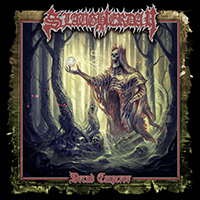 Let’s turn our attention to the upcoming album “Dread Emperor“, which will be even more compact than the already great “Tyrants Of Doom“. It’s rougher, more abrasive and more aggressive – without, however, throwing the typical SLAUGHTERDAY elements overboard. Did your work with REPULSION contribute to this?
“Maybe it’s just a slightly different approach this time: We have always focused on tempo changes, darkness and groove, but now we’re focusing more on classic, straightforward songs with hooklines that immediately catch the ear and ignite live. Working with REPULSION and the old NAPALM DEATH maybe gave us the little push in that direction. The EP showed us once again how much power there is in direct, compact aggression and that you can convey a tremendous amount of character even without frills. This inspired us to focus more on songwriting, live suitability and classic Death Metal structure on the new album – without losing the typical SLAUGHTERDAY haze and melancholy. In short: We have always been Death Metal, but now we’re more straightforward, crisp and classic to the point.“
So we let the cat out of the bag: “Dread Emperor“ is an outstanding album. The sound of ‘Golem’, this special PROTECTOR vibe, which is hollow, shrill and a little weird, seems to run through the whole record and promotes the more spontaneous, at times almost Thrash-like direction… So has your involvement with PROTECTOR left a similar mark on the album as REPULSION? Whether intentionally or unintentionally…
“No, PROTECTOR were not a direct influence on the songwriting or the sound of the new SLAUGHTERDAY record. It’s not something that was consciously incorporated. But what is absolutely true is that PROTECTOR has been with us since our childhood days. “Golem” was one of my very first records ever – a friend copied it onto tape for me back then, and for me at the time it was really one of the hardest things I had ever heard. That impression has never completely disappeared. That’s why what you hear there is less of a current influence and more of a deep, old anchor in our musical socialisation. A band that completely blew us away back then and that we still respect today. When I suggested to Bernd that we cover the song, he was immediately enthusiastic. So it’s not a conscious influence – it’s more our tribute to a band that shaped us very early on.“
 You say that spontaneity and a “just do it” attitude were extremely important for the album. But it’s the almost perfect balance between Doom and melody and rough Punk, Thrash Metal and the sudden switch or flow from one to the other that triggers part of the fascination with your music this time around. I’m thinking of ‘Astral Carnage’ or ‘Subconscious Pandemonium’ or even the title-track…
“We’re really happy about that, because it was precisely this dynamic that we found so exciting when writing. Spontaneity doesn’t mean throwing anything together haphazardly – it means trusting your instincts instead of overanalysing every transition. We really worked a lot from the gut on this album. If a riff suddenly called for doom, we went for it. If the energy suddenly screamed for a thrashy outburst, we just let it happen. And that’s exactly how those moments you mention come about: the sudden switch, this intertwining of slow heaviness and raw aggression. Songs like ‘Astral Carnage’ or ‘Subconscious Pandemonium’ thrive on this. There are changes that we’ve always had on previous albums, but perhaps implemented with more intellectualism. This time, we just did it and realised that it often benefits the song. And it’s similar with the title track: it almost seems as if everything is constantly pulling each other in like a maelstrom, and yet it remains to the point. Every riff is in the right place. Basically, our approach was: if it feels right, it’s right. And that’s exactly what made this mixture of Doom, melody and fast outbursts so organic. If it sounds so balanced in the end, it’s probably because we didn’t try to make it balanced on purpose. We just opened the doors – and the music did the rest.“
How often did you have to tweak things here and there to make sure there wasn’t too much melody or too much noise?
“Surprisingly, we didn’t have to make as many adjustments as you might think. Sure, we tweaked a few things later on, that’s just part of the process, but most of the balance between melody, doom heaviness and fast uffta-uffta came about quite naturally in the first moment of creation. We just relied heavily on our gut feeling. When we noticed, “Okay, now it’s leaning too much towards the melodic side“, we deliberately countered it with a harder part – but without that desperate “We have to balance this out now“ mindset. And vice versa: when something drifted too much into demolition, we often instinctively followed it up with a dark riff or a heavier part. But what we hardly ever did was “trim” things afterwards. The songs had to stay fresh. Spontaneity was our guiding principle – and as soon as you rework something too much, that’s exactly what gets ruined.“
 Despite the heavy-handedness, you always have the overwhelming feeling that everything comes across as totally harmonious just the way it is.
“That’s a great compliment, because it’s not that easy to unleash raw energy without everything sounding like a chaotic accident. But even here, it was less a matter of calculation and more a natural process. We’ve been writing music together for so many years now that we’ve developed a pretty good sense of when a song is ‘right’, even if it switches back and forth stylistically. Of course, it’s easier with just the two of us than when five people are adding their two cents and sensitivities come into play. The harmony you’re talking about usually comes about automatically for us because we speak the same musical language. Even when we go off on a doom-tangent or throw in some riff-based blasting, there’s always that dark SLAUGHTERDAY genetic resonating, holding everything together. And maybe it’s also because we never play Thrash and hit it just for the sake of thrashing and hitting it. Even the hardest parts have a function or a mood for us. When a song really hits hard, it still has to feel “beautiful” – not pretty, but logical. So harmony doesn’t come about through a lot of planning, but through a shared basic feeling for what sounds “right” to us. No matter how rough it gets, the music always falls back into our natural balance. We’re obviously delighted that this comes across so strongly when you listen to it. That’s ultimately the sweet spot we wanted to hit.“
I don’t want to go into individual songs, their meanings or anything like that… That would possibly destroy the completeness that the album has at first glance… Nevertheless, the album title draws a line to the present day. Have the many crude characters that the world knows influenced this record?
“We totally understand that – the album really works better as a whole experience, and dissecting it too much would take something away from it. But as far as the title and the “connection to the present day” are concerned: yes, you can read something into it, even though we didn’t try to make a directly social or political record. The world is full of crude characters, full of extremes, full of people who lose themselves in their own abysses – and that naturally creates a mood that you can’t completely ignore. We don’t live in a vacuum, after all. This strange mixture of chaos, brutalization, overload and simultaneous numbness… that was something that accompanied us while we were writing. In a way, “Tyrants Of Doom“ was also strongly influenced by this, and “Dread Emperor“ represents a certain natural development on the lyrical side. An analogy we often had in mind are the dragons that Ronnie James Dio often saw as a symbol of inner demons that need to be fought. Our lyrics are sometimes similarly cryptic, so that everyone can find their own interpretation. We don’t want to make simple statements or even point fingers – it’s more like a mirror that can be viewed in different ways. So yes, the world as it is right now has certainly cast its shadow on the album. But more as archetypes of inner and outer demons than as real figures. We paint pictures, we hold up mirrors – but we don’t tell stories. That’s exactly why the album remains so closed: it has its own world, fed by many impressions, without following a specific agenda.”
What a monster of a record! Here 2026 has its first album of the year!
www.facebook.com/slaughterdayofficial
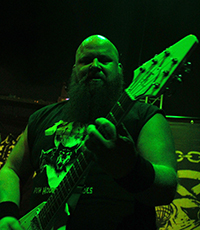
Interview & live pics: Wedekind Gisbertson