
 Craig, you described the album a year ago as falling somewhere between “Twisted Into Form” and “Omega Wave”. How satisfied are you with the result now?
“We are very satisfied, we all are extremely proud of the hard work and the fact that we pulled together to do this record. I think, it was more of a team effort than most of the FORBIDDEN albums, because everybody was completely invested in it. Different teams were working during different times – but we did some really great things. I’m really happy with it. And the reactions we’re getting so far, indicates that other people are very happy with it too.”
As one can read in the review about “Forbidden”, after countless spins, I really do love this album. So if I had to give it a score, the record would be really close to the highest possible score.
“Wooow! Thank you, that sounds fantastic. I really don’t know how to rate it yet, it not sounds like anything else, so I don’t think it is like anything else. All Metal is similar, all Metal is different. I just feel it is very true to what who we are as people in this world right now, with what’s going on. I would describe it as a good, solid parameter for where we are as humanity in 2026.”
Would you agree, if I said the record feels even more drawn out? It sometimes even reminds a bit of “Distortion” and ‘Sycophantasy’, featuring Brann Dailor from MASTODON, even remembers the way “Green” was structured? Quite complex in structure and nothing you can just listen to casually.
 “FORBIDDEN was never like that! I mean, we’re not background music. We require, if someone wants to get into our music, you have to really listen to it. Some people do like their Metal as background music, and that’s fine. There are people wearing their Metal more like a badge or a patch, while FORBIDDEN is more like a book. You gotta read it! If you don’t read it, you don’t understand what it is saying!”
The process of creating the “Forbidden” album took a very long time. You wrote and recorded songs with Daniel Mongrain, before you went on the summer tour 2025. Daniel went back to VOIVOD and Jeremy Von Epp joined the band – and you wrote and recorded songs again… How hard was it for you to keep track of everything?
“Well, when you’re talking about FORBIDDEN and talking about the songwriting, there’s always just one through-line, and that’s me. You know, for the most parts it starts and ends with my vision, but everybody contributes to it and adds own ideas, that’s a good thing, too. I delegate it. I want everybody’s heart and soul to be in it, so they shall write their own parts to whatever I write. At least to the most parts, that’s how it works. With Daniel I was really looking forward to write the album with, but he never had time to write. His schedule was gonna ramp up this year and I saw it coming. What he did do to the three songs, that we’ve recorded, which were ‘Divided By Zero’, ‘Mutually Assured Dysfunction’ and ‘Flower Of Life’ is, we’ve talked a lot and I discussed things with him, and told I wanted him to add things like he thought and he wrote some incredible parts to what was already written, but he did not change any arrangements in these songs. Some might think he had something to do with the orchestral parts in ‘Flower Of Life’, but he didn’t. He didn’t have time. That were really Chris Kontos, myself and some other musicians, we called in to help us with it. Daniel’s contributions to the album are amazing, but he didn’t bring any songs to the table to work with, because he didn’t have the time. So, that’s also why we ended up trying it with Jeremy. I saw 2026 coming, telling Daniel, he’s not gonna have time for any of the things we’re needed to do. So, we went to South America with Jeremy and afterwards played a show in Sacramento with him. And the crowd loved him, around here he’s a guitar hero, everybody around wonders why Jeremy didn’t make it to a bigger band. So, it just was a perfect timing. On the flight home, I was looking at him, he sat some seats away, I was looking at that guy, he was smiling and had fun. He is here, he lives in the Bay, he never had a big break and all of a sudden, I was like: Yes! That’s it, I really can imagine finishing the record with this guy! I can sit down and write the rest of this album with him. So, that is what we did, the last four songs we wrote on the record, him and I wrote together. It was really fun, having a songwriting partner that was there, physically and mentally at the same time. It was a really exciting finish line.”
 On ‘Sycophantasy’ you have Brann Dailor of MASTODON singing together with Norman. How did this collaboration came to happen?
“Well, I’ve been friends with Brann for a couple of years and personally, speaking for myself, I feel MASTODON and FORBIDDEN have a lot of similarities. Not literally musically, but artistically and philosophically. They do what they want to do. They’ve always done what they wanted to. And they aren’t bad when it comes to music either, I like to sit down listening to a MASTODON record. So we had this natural respect for one another for our bands – they had more success obviously! Then they had to go through that change, which had a really sad reason. Even after Brent had passed away, I approached Brann and we’ve been talking through all that. He knows how much I respect him and love his band, so I asked him, if he’s intrested in singing a song on the record and he said: Absolutely! He did not even hesitate. He said, send me what your ideas are. In that song, there is two roles being played, one is the oppressor, the narcissist and the other one is the sycophant. So Brann happily took on the role of the sycophant, which sounded really cool to him. I’m still blown away, how cool he sounds and how good the song turned out. ‘Sycophantasy’ is a very different song. As you mentioned “Green” before, sure somehow, but the song is tuned to E and nothing on “Green” was tuned to E, everything on that record was simply just tuned down…”
To what extent have developments in the USA – such as these ICE militias, their murders and violence, as well as the overall restrictive political climate in your country, had an influence on this album?
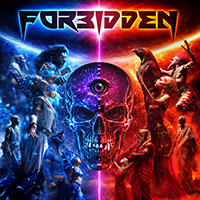
“I think, it has an influence on every American in many different ways. You’re either aware of the disturbance in the force or you’re in denial. You know, this country was looked upon and was looked up to it many many ways. “But see, oh no, the country is corrupt!”, I mean anyone has their dirty secrets and ways how to backchannel money and everything like that. I think, below the surface level there was at least something to look up to, and I feel like we’re losing that – it is almost completely lost! Everyone got their own personal feelings on things, but to us on this album it’s an overarcing everything. It is not a one thing or one side. It is more the human conditions morphed into one. And that’s what you see in the cover, too. The two skulls turned into one, and that is your decisions. That is how you live your life – I think there’s a lot more inclusiveness and less, you know, picking sides. I think we just tell the story of our time. This is it, we’re trying to writing the memoires from within the eye of the storm.”
 Did you arrange all the songs on the album according to a specific pattern, organize them by theme, or something along those lines?
“Yes! It’s a matter of fact. When you have the vinyl version, you’ll see it for yourself. There are four quadrants on the record, songs grouped in three, three, three and two… And the last two being a space opera, with ‘Sol Grave’ and ‘Flower Of Life’. But everything is kind of based upon different psychologies and confrontational stuff and so. But it is in pieces. So when you listen to the record, and it is a long one, it goes an hour and four minutes… maybe not too pleasant to nowadays attention span, but the flow of it and the arrangements on it, it’s all by designed and I think it’s pretty perfect. I feel like, those three songs, three songs, three songs and then two songs all have a natural flow to them.”
I also had written down on my question-sheet: the first three songs seem to belong together somehow, at least musically. So that underlines exactly what you say.
“And then the next three definitely belong together, and then the next three… I don’t want to say they are concept, because they are not – but they all kind fit together philosophically. The last two being the real SciFi space opera. Actually it’s not really science-fiction, but science. ‘Sol Grave’ itself is written from the point of view almost like an opera and it’s about when the final starway, that we see on earth, passes us by. Because it all is a time-machine in the first place, right? You don’t see anything happen in real time, you see things from all these million and billion light-years ago, and all that light will be extinguished!”
Have you been writing these type of lyrics on this album together with Norman Skinner?
“Well, this was the coolest thing for me. Because I’ve written the majority of FORBIDDEN lyrics for so long. It kind of just been all in my hands, Russ (Anderson, former vocalist) didn’t really want to do that kind of work, he liked more the melodies, so he went for working on melodies and then I’d write a lot of lyrics, whatever! But this relationship turned out to be different, the first song I came up with, was ‘Divided By Zero’ and I had a chorus and I had the beginning of a verse and I gave it to Norman, saying: “Here’s a good start for you…” and I explained to him what I wanted to write about and mentioned: “Maybe you can work out something more?” And he came back to me and he had finished it! And he had written great lyrics and melodies. So I was like: “Hah! Okay, well here’s the next song…” And I gave him each title and what I wanted the song to be about as we are moving along. So most of the songs came from my titles and concepts, and then he did the research, he read all about it and he loved it. He is like: “This is inspiring! If you give me something, I can run with it…” That was also great for me, because I now can read the lyrics and I like them better, because I didn’t fuckin’ write them! And I prefer having somebody else them singing, be the catalyst. We also got some help from Chris Kontos on subject matters. I had this song ‘Flower Of Life’ and I knew it was sacred geometry and I knew what it was about, but Chris turned out to be a freak for that. He came to Norman and me and told us, what’s really down into this. So we wrote these lyrics together. Chris also had this idea for ‘The Burden’, I had a different subject for it. He wanted to make it about the burden that women feel with men relaying on them as much as they do but not really wanting their opinion when push comes to shove. Pushing them off to the side – but they are the neck that turns the head, so to speak. Probably the most brutal women’s liberation song ever! But Chris also brought the decisive idea for ‘Sol Grave’, by mentioning the extinguishing of all the starlight. And I was: “Oh, fuck, yes, that’s it!” And Norman out of the background: “I got that!” It was a really cool group effort when it came to that. Most of all the subjects and titles came from me, but everyone contributed. At least us three.”
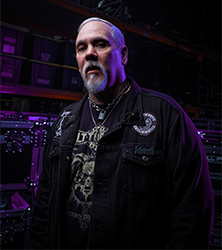 For me one of the big surprises on “Forbidden” is ‘Jesei’ – usually I run away when it comes to ballads, but this track is beautiful. Maybe it’s not even a ballad, because it touches something primal.
“Well I mean, I wrote that in the room over there and I remember, I sat with the guys and told them, that I want something acoustic on this record, there I still thought this song is going to be an instrumental. I called it ‘The Force Of The Dead’, based upon this Japanese forest under the Mount Fuji, where people go to die. Again it was Norman then, he liked the idea with this Japanese suicide forest, so he told me: “No, it’s not going to be an instrumental, let me write some lyrics to that.” So he did and then we did… Basically the music to it came up within one day. I felt like we needed something like ‘Spiral Depression’ from “Twisted Into Form” also for this album, simply to give the listener some time to breathe, because the record is so long. So I think, ‘Jesei’ is just put into the right spot.”
Translated, the word ‘Jesei’ means something like ‘death poem’ or ‘poem to death’. Listening to that song always makes me wonder, how one can associate death with such type of harmonies and melodies. And the fact that one is singing so beautifully about death is incredible.
“Right. I have to give Norman this flowers here… He really is a brillant songwriter, even when he always had more Power Metal in his life and he never had a Thrash Metal background. But exact that is, what always worked in FORBIDDEN, and it always has, Russ also had that, even if it wasn’t so much the Power Metal thing but more classic Metal, like IRON MAIDEN, JUDAS PRIEST, DIO and that stuff. So I feel like, Norman fits in so perfectly, he just completes the sentence of whatever music we put out. I love how beautiful his melodies are, when I get to the end of this song, while listening to it, I often get a bit emotional, because the apologies to the loved one: “I’m sorry, I’m so sorry!” That’s like: Woow, it gets me almost every time…”
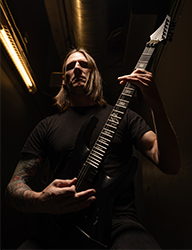 I’ve read that in Japan, death doesn’t really have a gender. I don’t know how it is in America; over here in Europe, people tend to associate death with a male figure.
“The mind is a multiverse, right? And we all have our own versions of reality, that is some sort of infinite space. I’m trying not to get too deep here, but quite frankly, perception is reality to each person’s perception! Whatever you believe in your mind, I believe, is your reality!”
Who actually came up with the brillant idea of writing the number of the beast in Roman numerals and using it as a song title?
“That was me. Not only that, I was sitting in a room writing some other stuff, it was Chris and me. All of a sudden, it came to my mind: The roman numerals for Six Six Six – I wonder what that is? So I pulled out my little hell-on-earth and looked it up and literally the first thing I did was to take my guitar and go like D, C, L, X, V, I… That was the first thing I came up with, and the just laughed, that was too fuckin’ much. But I did know what I wanted to write about, that was the fall of the Roman Empire to the beginning of Christianity, how all the hunters became the hunted, the persecutors became the persecuted. Back then, you went very quickly from a christian being fed to the lions to a pagan. The same state of lies, it just goes to show you the power of religion fooling people in a mass hypnosis. I thought it was an intresting subject and then Norman did an amazing job again, writing the lyrics and telling the story of the influence of the time and the beginning of Christianity. It’s cool, it was fuckin’ awesome how it worked.”
What really catches my attention in this track is how Norman’s voice – which at times seems fragile – appears to be the perfect counterpart to Chris Kontos’ powerful, punchy drumming, which also adds something unique to this album.
 “That’s what FORBIDDEN is! Counterpart, that’s a good catch! Everyone has got his traits, and I can tell you whatever one elses traits are, my maybe lone superpower that I really have is that I have an overview of balance, like knowing how to balance something. To me something is not right until it’s balanced and that keeps applying in any case, whether it’s musically, lyrically or melodically. I just want for each FORBIDDEN song to have its balance within itself. They don’t need to be like each other, but from front to back they need to have balance. So we managed to find the exact balance, sometimes something extremely heavy, musically, needs to find its counterbalance in something tender and precious, vocally as well as melodically. It’s a place, I think, that not a lot of bands do have the confidence to go. I think we operated rather good in that space…”
It appears to be a very balanced album from the beginning to the end, but one has to get into it. It will be intresting how “Forbidden” works within our sipirit of the age, where people don’t have that big attention span anymore. It will be exciting to see what those four chapters on the album as well as every single track is to saying to those, who really listen closely.
“Saying to them, exactly. That’s exactly right. It’s not about what they’re saying, but what they say to you. I think that is something really important, to not over-explain things. So let some things just stand there and be perceived amongst theirselves, I don’t think people want to be told, how they should think!”
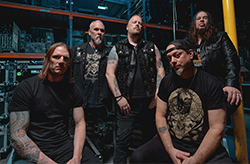 That brings me to the next question. The album artwork had been online for less than a few hours when the first comments started popping up, claiming it was all cobbled together using artificial intelligence. A few days later, I read an interview with, I think it was Norman, in which he explained that it wasn’t artificial intelligence – so can you shed some light on this?
“Well, I think it really is AI – on the other hand it also is not! There is an ignitial starting-point, because Beto Ferris, he’s a fantastic artist, we came across with after he did AI-interpretations of “Forbidden Evil”. So I thought: Oh, that’s cool, that’s intresting – I wonder what this guy can really do? And then we found out what he could really do! Basically what he could do together with us, was working so deeply within the artworks like never before. We got every little detail of what was in our minds, of what we wanted to see. There is nothing on the artworks we did with him, what we didn’t want to exactly be there. You can’t do that with AI, that doesn’t work. AI makes kind of something and that’s what you got! Working with an artist like him starts like I explain to him what I want to see, drawing a little sketch picture. All of this starts very rough and over the time we work and we work and chizzle and chizzle. Today I’d even say it’s better than working with painters in a way – because they don’t want to have someone standing over their shoulder telling him how to paint, right? That’s not acceptable. At this state of our work, I didn’t want to just hand it over to a painter to do all these things, because they might not do it right and then you’re fuckin’ stuck because of that. And we can’t have that! This one place, I really think that technology comes in handy, is in the medium of movies… And I feel like all of our artwork appears to be more like a movie. It’s far more like in a Marvel universe than some flyers or posters glued to some phonecall cells or backyard walls.”
So how do you deal with people who insist they’ve discovered artificial intelligence here?
“I find that all the people who can’t understand it and think it is all AI, are triggered. Which is fine to me. Some people may find it pretty dishardening, but I don’t care. Because I know how it was done! So I just gonna laugh at it. To me it appears a bit like, there’s a lot of gatekeepers now. And these gatekeepers are kids, that wish they would have lived in our era and wish they could have done what we did when we did it and had it as primitive as it was when it was. But, we kept our music primitive. We kept the recording process primitive, we didn’t overdo all the technology, we didn’t lean into fixing everything, we kept things raw. So our music has all the same qualities, that our old music used to have.”
 The creatures to the left and right of the skull – what do they represent?
“You’re stepping into dangerous territory, talking about over-explaining and all that. But they represent us as well as they represent choices. Human nature and where we are. It’s all in this picture, also all the arguments the kids are having about technology’s taking over. It’s all right there. You have your ‘organic’ side and you have your ‘bio-technology’ side, and we are in the middle of that and our third eye there, in the middle of the picture, is being distorted, twisted and manipulated and that is essentially what the skull stands for. The figures on the outsides are representatives of prehistoric gods, gods of megalithic civilisations – which are connected to the song ‘Flower Of Life’ also, they represent both, good and evil, but they didn’t call it good and evil. They didn’t have this distinction – they were what they were! I think, we humans have that common conclusion that we are, whatever our decisions are. You can say this one is evil and this one is good, but your mind can turn on a dime about those decisions and become either one of these things. That’s why it’s all morphed together, this is the answer, everything is conglomerated and glued together and this is where we are as a society right now.”
Anyone who follows you even a bit on social media, keeps coming across photos of your trips to Europe, which you enjoy taking with your wife, even when you’re not on concert tours. What does Europe mean to you?
“That’s right, I do have a special relation to the Netherlands and Belgium and we spent a lot of time in Italy last year, in Florence. I never had the time to see and explore Florence or any part of Italy before, because with the band it is always an in and out, you know? But I need to say it was really really nice. Yeah: I love Europe, I love the culture and all that, I love all the countries for different reasons. And there’s a lot of great people around. But yes, there are great people everywhere, I don’t care where you are. I love Europe and I was honestly sad when we needet to cancel our summer tour, but it just would have been stopping us again, getting the album done. So I’m looking forward to come back next year!”
You’re welcome, Craig. You know that…
www.facebook.com/forbiddenofficial
Photos: Phil Emerson
Interview: Wedekind Gisbertson